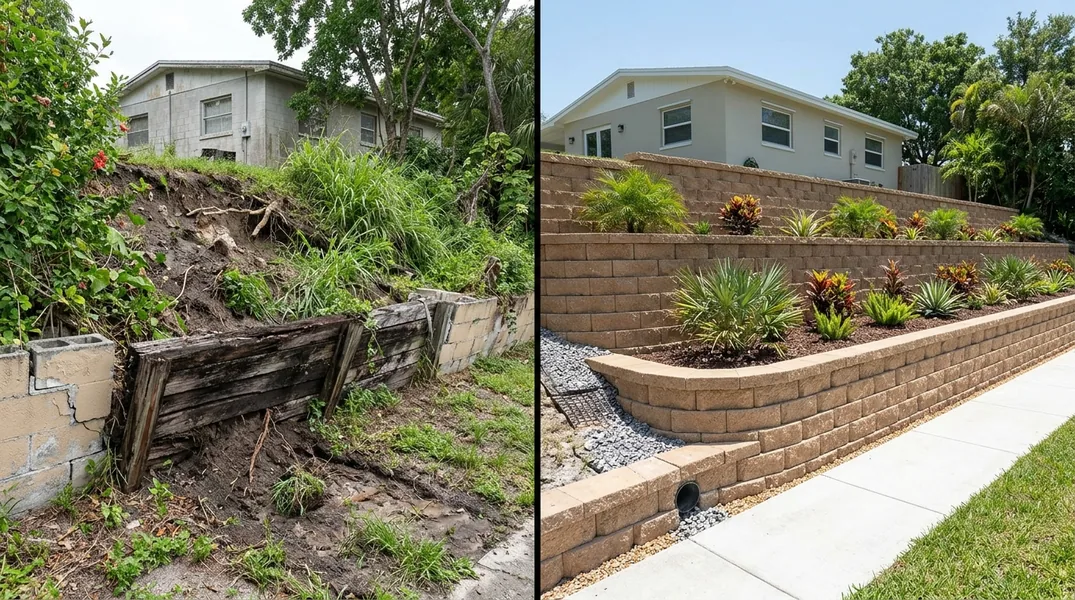
Why Miami's Hurricane Season Is So Hard on Retaining Walls
If you own property in Miami, you already know that hurricane season, which runs from June through November, brings more than just wind. It brings torrential rain that can dump several inches in a single afternoon. When that water saturates the soil behind a retaining wall, it has to go somewhere. If the wall's drainage system is undersized, clogged, or missing entirely, that water becomes the single greatest threat to the structure.
The problem is that most retaining wall failures we see in South Florida are not caused by the concrete or the block cracking under their own weight. They are caused by water. Saturated soil becomes dramatically heavier, and it also pushes outward against the back of the wall. This is the core of what engineers call hydrostatic pressure, and it is the quiet force that topples walls after a heavy storm. A wall that looked perfectly fine in February can lean or crack by September if the water behind it has nowhere to drain.
Hydrostatic Pressure: The Invisible Force Behind Most Wall Failures
To understand hydrostatic pressure, picture a sponge full of water. The water adds weight and pushes in every direction. Now imagine that sponge is the soil behind your wall. During a hurricane or even a routine summer downpour, water fills the voids between soil particles faster than it can escape. The pressure builds against the back of the wall and, if the wall cannot relieve it, the wall moves. It might lean forward at the top, bow outward in the middle, or develop diagonal cracks near the corners.
This is why the best Concrete Retaining Walls are not just thick and well reinforced. They are designed with a drainage plan from day one. That plan typically includes gravel backfill, a filter fabric to keep fine soil from clogging the system, and a way for water to exit at the base. Without those elements, even a strong concrete wall is fighting a losing battle against water pressure that can exceed thousands of pounds per square foot during a major storm.
What a Retaining Wall French Drain Actually Does
A Retaining Wall Repair project often begins with a simple question: where did the water go? The answer should be a retaining wall french drain. This is a perforated pipe, usually wrapped in filter fabric and set in a bed of washed gravel, that runs along the base of the wall on the uphill side. As groundwater collects, it enters the pipe through the perforations and flows away from the wall to a safe discharge point, such as a storm drain, a dry well, or a graded swale.
When a french drain is working correctly, it keeps the soil behind the wall from becoming saturated. That reduces hydrostatic pressure and protects the wall from the freeze-thaw and expansion cycles that are less common in Miami but still relevant during heavy rain events. It also helps prevent erosion of the soil beneath the wall's footing, which is another common cause of settlement and collapse. In short, the french drain is the unsung hero of every long-lasting retaining wall in South Florida.
Signs Your Wall's Drainage Is Already Failing
Homeowners in Hialeah and across the region often call us after they notice water pooling at the base of a wall or soil washing out from underneath it. Other warning signs include a white chalky stain on the face of the wall, which indicates water is pushing through the concrete, and soft, soggy ground behind the wall even days after rain. If you see any of these, it is worth having the wall inspected before the next storm arrives.
Another red flag is a wall that has started to lean. A small lean can become a full collapse once the soil behind it is saturated. In many cases, a timely Retaining Wall Repair that restores the drainage system can save the wall at a fraction of the cost of a full rebuild. Waiting until the wall has visibly failed usually means a Retaining Wall Replacement is the only option left.
Retaining Wall Installation Near Me: Getting the Drainage Right the First Time
If you are planning a new wall, the most important decision you will make is not the color of the block or the height of the wall. It is who installs it and whether they understand drainage. A proper Retaining Wall Installation in Miami should always include a site assessment that looks at how water moves across your property during a storm. The contractor should design the wall with adequate gravel backfill, filter fabric, and a french drain that ties into a reliable discharge point.
This is especially true in low-lying neighborhoods and areas with high water tables. In those conditions, a wall that lacks proper drainage can fail within a single hurricane season. If you are searching for retaining wall installation near me, look for a contractor who can explain exactly where the water will go and who is willing to show you the drainage plan before work begins. That level of detail is what separates a wall that lasts decades from one that becomes a repair bill after the first major storm.
Protecting Your Investment Before the Next Storm
The good news is that drainage failures are preventable. If your wall is older or you are unsure about its drainage, a professional inspection can identify clogged pipes, missing filter fabric, or poor grading before the next named storm forms in the Atlantic. In many cases, the fix is straightforward: clean or replace the french drain, regrade the soil, and restore proper flow away from the wall. For walls that have already begun to move, a targeted repair can often stabilize the structure and extend its life.
At Miami Retaining Wall, we help homeowners across Coral Gables and the surrounding areas protect their walls with drainage-first designs and honest assessments. If you would like to know what a drainage upgrade or repair would involve, call us at (786) 741-7917 or request a free estimate. You can also review our pricing to get a general sense of what different projects cost. The best time to address drainage is before the rain arrives, not after the wall has already started to lean.
Looking for a professional retaining wall contractor in Miami? Miami Retaining Wall responds fast for all your retaining wall needs.
Get a Free QuoteOur services: Retaining Wall Installation · Retaining Wall Repair · Retaining Wall Replacement