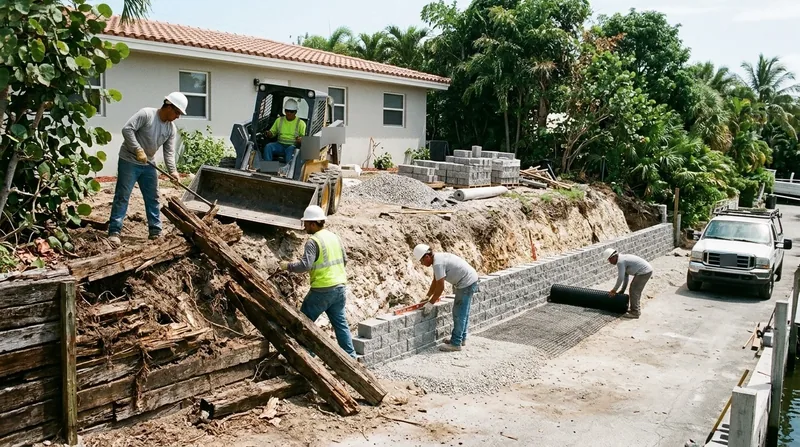




Retaining Wall Replacement in Miami: Rebuild on Solid Ground
Miami sits on flat, low ground over porous oolitic limestone, with thin sandy soil and a water table only a few feet down. That means most retaining walls here are not holding back mountains, they are holding back saturated fill, pool decks, planters, and raised pads. When a wall starts to lean, crack, or bow, it is usually because water found a path and the original build never handled it. We do Retaining Wall Replacement in Miami as a full tear-out and rebuild: demolition, haul-away, new drainage, and modern materials that match the lot. If your wall is still standing but moving, start with leaning and collapsed wall repair before you commit to a full replacement.
Why Retaining Walls Fail in Miami's Limestone and High Water Table
Miami's failure mode is water, not frost. Hurricane rain dumps inches in hours, king tides push groundwater up through the limestone, and salt air eats at mortar and steel. Older walls in Coral Gables and Miami Shores were built as stuccoed CMU or coral rock with little or no drainage, so hydrostatic pressure builds behind them until they crack or tip. In Kendall and Doral, 1970s to 2000s subdivision walls around lakes and canals often sit on raised pads that settle unevenly.
- Walls bow or lean because water pressure builds behind them with no relief path.
- Stucco cracks and spalls as salt air and constant moisture break down the finish.
- Timber and railroad tie walls rot fast in Miami's wet soil and attract termites.
- Tree roots from ficus and oak push walls out of line and open joints.
- Footings undermine when groundwater rises and washes out the base.
Replacement fixes the cause, not just the face, when the new wall is built with drainage and a footing sized for Miami's water table.
Key info: A pool deck wall in a Coral Gables 1920s Mediterranean Revival property often fails at the footing, not the block. Rebuilding the same wall without a drainage plane and gravel backfill just resets the clock.
Miami-Dade County publishes its building permit rules and inspection requirements through the local building department, and thresholds for walls above roughly 4 feet or walls carrying a surcharge should always be confirmed there before work starts: Miami-Dade County Building Department.
How We Replace a Retaining Wall in Miami, Step by Step
We start by finding out why the old wall failed, because a replacement built the same way will fail the same way. On a typical Miami lot we check the water table, the soil, the slope, and what the wall is holding up. Then we sequence demolition, drainage, and rebuild so the yard stays usable and the new wall drains from day one.
- We inspect the wall, footing, and drainage path, and we check the property line and any permit threshold with the local building department.
- We demolish the failed wall and haul away block, concrete, timber, or coral rock debris.
- We excavate to stable soil and rebuild the footing sized for the wall height and surcharge.
- We install gravel backfill, filter fabric, and weep holes or a drain line so water exits instead of pushing.
- We set the new wall in segmental block, poured concrete, or natural stone to match the house and neighborhood.
- We compact, backfill, finish the cap, and clean the site before we walk it with you.
Every replacement ends with a drainage system, because in Miami the drainage is the wall.
Key info: A 1970s Kendall subdivision wall around a lake lot had settled and was holding back saturated fill. We tore it out, rebuilt the footing above the seasonal water line, and added a drain line to the canal side. The new wall has not moved through two hurricane seasons.
If the wall is sound and only the drainage has failed, retaining wall drainage work is often enough. If the wall is gone, replacement is the honest answer.
Replacement Approaches We Use Across Miami
The right material depends on what the wall holds, how tall it is, and how the lot drains. We match the approach to the property instead of forcing one system onto every job.
| Approach | Description | Best for |
|---|---|---|
| Segmental block replacement | Engineered block with geogrid and gravel backfill, rebuilt from the footing up. | Planter and pool deck walls in Kendall, Doral, and Palmetto Bay. |
| Poured concrete replacement | Steel-reinforced concrete wall with a formed footing and drainage plane. | Tall walls and walls carrying a driveway or structure surcharge. |
| Natural stone and boulder rebuild | Coral rock or boulder wall reset with proper batter and backfill. | Coral Gables and South Miami properties matching 1920s coral rock walls. |
| Timber and railroad tie tear-out | Rotting ties pulled, hauled, and replaced with block or concrete. | Miami Shores and Little River yards with 1930s to 1950s timber walls. |
We choose the approach after we see the lot, not before, because Miami's water table and soil change from block to block.
Retaining Wall Replacement Cost in Miami: What to Expect
Replacement pricing starts from $35 per square foot of wall face, and that figure covers tear-out, haul-away, a new footing, drainage, and the new wall. Real jobs move off that number based on height, access, and what the wall is holding. A low planter wall on an open lot in Homestead prices differently than a tall wall tight against a pool deck in Miami Beach. For a fuller breakdown by wall type and height, see the full pricing overview.
- Wall height and length drive the square footage and the footing size.
- Access matters: a wall behind a house or tight against a seawall takes more labor.
- Surcharge loads, such as a driveway or structure above the wall, require engineering and thicker sections.
- Material choice, from segmental block to poured concrete to coral rock, changes the unit price.
- Haul-away of old concrete, timber, or coral rock adds disposal cost on some lots.
Get two or three estimates on the same scope so you compare like for like, and ask each contractor to explain the drainage plan in writing.
Retaining Wall Replacement Near Me: How to Vet a Contractor Near Miami
Hiring for a wall replacement near Miami comes down to proof, not promises. Ask for the license and insurance certificate, then verify the license with the state. Ask for references from jobs in your city, and ask how they handled permits and drainage. A contractor who cannot explain the drainage plan before the contract is a contractor who will not build one.
- Confirm the contractor is fully insured, and ask for the certificate before work starts.
- Get multiple estimates and compare scope line by line, not just the total.
- Check references for walls built in Miami, Hialeah, or Coral Gables within the last few years.
- Confirm who pulls the permit and whether engineered drawings are required for your wall height.
- Ask about HOA approval and any property line or setback rules before demolition.
When you are ready to talk through your wall, contact us for a free estimate and we will tell you honestly whether replacement is the right call.
Retaining Wall Replacement in Miami: Pricing Guide
| Service | Price | Details |
|---|---|---|
| Segmental block wall replacement | Starting at $35/sq ft | Includes tear-out, haul-away, new footing, gravel backfill, and drainage; height and access move the price. |
| Poured concrete wall replacement | Starting at $55/sq ft | Includes formed footing, steel reinforcement, and drainage plane; surcharge loads and wall height raise the rate. |
| Natural stone or coral rock rebuild | Starting at $60/sq ft | Includes stone reset with proper batter and backfill; stone sourcing and tight access add cost. |
| Timber and railroad tie tear-out | Starting at $30/sq ft | Includes removal and disposal of rotted ties plus new block or concrete wall; termite damage and haul distance affect price. |
| Travel | Included | in Miami and surrounding areas, no separate call-out or mileage fee |
| Estimate | Free | Response within 24h at (786) 741-7917, no obligation to book |
Indicative pricing, the exact cost depends on square footage, finish, and site access. Free personalized estimate within 24h at (786) 741-7917.


