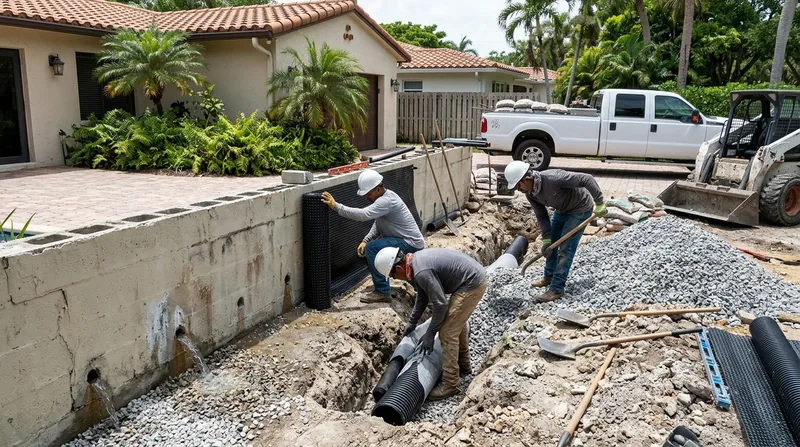




Retaining Wall Drainage in Miami: Keep the Water Moving and the Wall Standing
Miami sits on porous oolitic limestone with a water table only a few feet below grade, so retaining wall drainage in Miami is not a cosmetic add-on. It is the difference between a wall that holds and one that leans within a season. The ground here is flat and thin over the rock, and the limestone ridge through Coconut Grove, Coral Gables, and South Miami is the highest natural land in the city.
When a hurricane or a summer squall dumps rain, water backs up behind walls that have no relief path. Hydrostatic pressure builds, the soil turns to slurry, and the wall pushes forward. We design and install French drains, weep holes, gravel backfill, and waterproofing that give that water somewhere to go. If your wall is already moving, start with leaning and collapsed wall repair and we will assess the drainage at the same time.
Why Drainage Decides Whether a Miami Wall Survives
Most walls we open up in Miami fail for one reason: water had no exit. The soil behind the wall sat saturated, the deadman or geogrid lost its grip, and the block or concrete face started to rotate. This is especially true in Kendall and Doral subdivisions built around lakes and canals from the 1970s through the 2000s, where raised pads and fill soils trap water.
- Hydrostatic pressure pushes saturated soil against the wall face harder than dry soil ever will.
- Weep holes clog with silt and roots, so the wall loses the only relief it had.
- Gravel backfill without filter fabric silts up and stops draining within a few years.
- King tides and heavy rain raise groundwater behind seawall lots on Miami Beach and low blocks near the river.
- Salt air and tree roots crack stucco and open paths for water into CMU and coral rock walls.
We treat drainage as structure, not trim. Every wall we touch gets a water path designed for the actual soil and water table on that lot.
Key info: In Coral Gables, 1920s Mediterranean Revival homes often have coral rock walls with no weep holes at all. We core new drains and add gravel backfill before the wall moves another inch.
Check the local building department for permit thresholds before any drainage work that changes grade or footing, since rules vary by jurisdiction and wall height.
How We Diagnose and Fix Retaining Wall Drainage in Miami
We start by reading the water, not the wall. Where does rain sheet off the roof? Where does the neighbor's yard drain? Is the water table sitting a foot under the footing? We probe the backfill, check for silt and roots, and look at the wall batter to see how much movement has already happened.
- We walk the site and mark the low spots, downspouts, and any ponding against the wall face.
- We excavate behind the wall to expose the backfill and confirm whether a drain already exists and is clogged.
- We install a perforated French drain at the footing with washed gravel and filter fabric, then daylight it to a safe outfall.
- We core or clear weep holes at the base and set them so they cannot be blocked by soil.
- We waterproof the wall face where it is below grade and rebuild the backfill in compacted lifts.
We finish by testing the flow with a hose before we close the trench, so you can see water leaving the wall.
Key info: On a segmental block wall in Doral (33172), we found the original builder had backfilled with sandy soil and no gravel. We replaced 40 feet of backfill with washed #57 stone, added a French drain, and the wall stopped moving. See our Doral drainage page for that area.
Drainage Methods We Use on Miami Walls
No single method fits every wall. A stuccoed CMU planter wall in Miami Shores needs different relief than a boulder wall on a slope in Palmetto Bay. We match the method to the wall type, the soil, and where the water can legally go.
| Approach | Description | Best for |
|---|---|---|
| French drain at footing | Perforated pipe in washed gravel with filter fabric, daylithed to a safe outfall. | Walls holding saturated soil, especially on raised pads in Kendall and Doral. |
| Weep holes and gravel backfill | Cored or block-out openings at the base with clean stone behind the wall face. | Stuccoed CMU and concrete walls in Miami Shores and Little River. |
| Waterproofing membrane | Fluid-applied or sheet membrane on the below-grade face before backfill. | Coral rock and concrete walls where salt air and damp have opened cracks. |
| Surface and downspout control | Regrade, extend downspouts, and add swales to move roof water away from the wall. | Walls with ponding at the top, common on flat lots across Miami. |
| Chimney drain in slope | Vertical gravel columns through the slope to intercept water before it reaches the wall. | Slope stabilization jobs where groundwater seeps above the wall. |
We pick the combination that fits your wall and your lot, not the one that is easiest to sell.
Retaining Wall Drainage Cost in Miami: What to Expect
Most drainage work in Miami starts around $2,500 for a focused repair: clearing or coring weep holes, replacing failed backfill with gravel, and adding a short French drain run. From there, cost tracks the length of wall, access to the back side, and how much soil has to come out and go back in.
- Wall length and height drive the amount of gravel, pipe, and fabric, so a 60-foot wall costs more than a 20-foot planter wall.
- Access matters on tight lots in Coral Gables and Miami Beach, where a machine may not fit and hand digging takes longer.
- Wall type changes the method: coral rock and CMU need coring, segmental block needs the cap and top courses pulled.
- Outfall is a real cost. If water has to be pumped or routed to a storm drain, that adds labor and sometimes a permit.
- Urgency counts. A wall already leaning may need shoring before drainage work starts.
Get two or three written estimates and compare the scope, not just the number. Our full pricing overview shows how the line items break down.
What to Look For When Hiring a Retaining Wall Contractor Near Miami
Drainage work is easy to hide, so hire someone who will show you what is behind the wall.
- Confirm the contractor is fully insured in Florida and ask for the certificate before work starts.
- Get at least two or three estimates and check that each one includes excavation, gravel, pipe, and outfall.
- Ask for references from jobs in Miami, Hialeah, or Miami Beach with the same wall type as yours.
- Check permit requirements with the local building department, especially for tall walls or work near a seawall.
- If you are in an HOA, get the drainage plan approved before anyone digs.
We walk every job before quoting it, and you can request a free estimate to get that conversation started.
Retaining Wall Drainage Near Me: What Miami Homeowners Should Know
When you search for retaining wall drainage near me, you are usually looking at a wall that is already showing signs: rust stains, a bulge, soggy soil at the base, or water in the yard after rain. In Miami, the dominant failure is rain-driven washout and hydrostatic pressure on walls built without relief. The fix is almost always drainage first, then repair if the wall has moved.
We serve Miami and the surrounding cities, and we can tell you quickly whether your wall needs drainage alone or retaining wall repair as well. Call (786) 741-7917 and describe what you are seeing.
Seasonal Timing for Drainage Work in Miami
Miami does not have a frost season, so drainage work runs year round. The pressure point is the rainy season from May through October, when afternoon storms and hurricane rain load walls that were already holding too much water. The dry winter months are the best time to open a wall, inspect the backfill, and rebuild it before the next wet season.
If your wall is leaning now, do not wait for the dry season. A wall that has moved needs attention before the next storm, and we can usually get out within a day or two.
Drainage and the Rest of Your Wall System
Drainage does not stand alone. It works with the wall material, the footing, and the slope above it. If you are planning new work, our retaining wall installation page covers how we build drainage in from the start. For older timber walls that have rotted at the base, railroad tie wall replacement is often the better path than trying to drain a failing wall.
We look at the whole system because that is what keeps the wall standing through the next hurricane season.
Retaining Wall Drainage in Miami: Pricing Guide
| Service | Price | Details |
|---|---|---|
| Weep hole and gravel backfill | Starting at $2,500 | Clearing or coring weep holes, replacing failed backfill with washed gravel, and adding filter fabric on a short wall run. |
| French drain installation | Starting at $3,800 | Perforated pipe, washed stone, filter fabric, and daylight outfall along the wall footing, priced by wall length. |
| Waterproofing and drainage combo | Starting at $4,500 | Below-grade membrane, new backfill, and weep holes for coral rock or CMU walls with salt and damp damage. |
| Complex or large-scale job | On estimate | Tiered walls, tight access, shoring needed, or storm drain outfall requiring a permit need an on-site look first. |
| Travel | Included | In Miami and surrounding areas, no separate call-out or mileage fee. |
| Estimate | Free | Response within 24h at (786) 741-7917, no obligation to book. |
Indicative pricing, the exact cost depends on square footage, finish, and site access. Free personalized estimate within 24h at (786) 741-7917.


