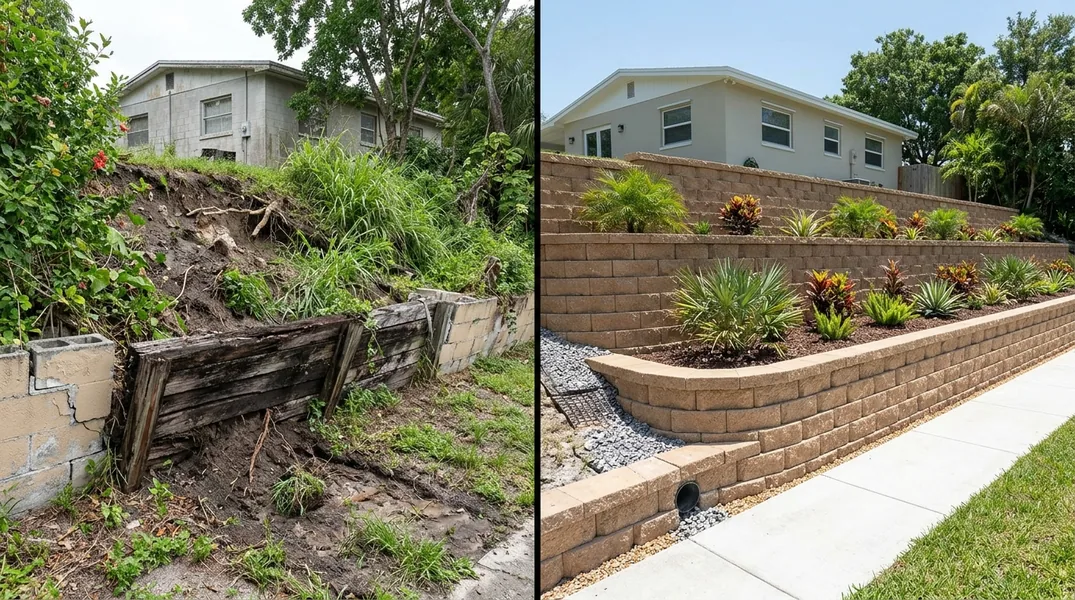
Why Miami's Soil and Water Make Retaining Wall Material Choice Critical
Building a retaining wall in Miami is not the same as building one in Atlanta or Denver. The combination of porous limestone bedrock, sandy fill soils and a water table that can sit just a few feet below grade creates conditions that punish the wrong material choice. A wall that looks solid on installation day can lean, crack or settle within a couple of rainy seasons if the material and drainage system are not matched to the site.
Limestone in South Florida is relatively soft and can be excavated, but it also holds water and creates perched water tables after heavy storms. Sandy soils drain quickly but lose bearing capacity when saturated. High groundwater means hydrostatic pressure builds behind a wall faster than many homeowners expect. That is why the best material is not simply the strongest one on paper, but the one that works with local drainage, movement and maintenance realities.
Concrete Retaining Walls: Strength for High-Load and High-Water Sites
Concrete Retaining Walls are the go-to choice when a wall must hold significant grade change, support a driveway or pool deck, or resist constant hydrostatic pressure. Poured concrete can be engineered as a cantilever or gravity wall, reinforced to handle Miami's sandy backfill and designed with weep holes and drainage gravel to relieve water buildup. For homeowners in Coral Gables dealing with mature trees and tight lots, a poured wall can also be shaped to fit awkward property lines.
The trade-off is cost and cure time. Concrete walls typically require formwork, rebar and a longer schedule than block systems, and they need proper control joints to manage cracking. When they are detailed correctly, though, they deliver decades of service with minimal movement. If your project involves a tall wall, a surcharge load from a structure above, or a site where groundwater stays high year-round, concrete is often the most reliable path. A professional Retaining Wall Installation contractor can tell you whether a poured wall or a segmental system makes more sense for your specific lot.
Block and Segmental Retaining Walls: Flexibility and Curb Appeal
Block retaining walls and segmental retaining walls are the most common choice for residential projects in Miami because they balance cost, appearance and constructability. Segmental systems use interlocking units that flex slightly with soil movement, which is a real advantage in sandy soils that shift after heavy rain. They also drain well when installed with proper gravel backfill and geogrid reinforcement, reducing the risk of water pressure building behind the wall.
Block walls come in a wide range of colors and textures, so they can match the stucco and stone look popular in Hialeah and across South Florida. The key is installation quality: base preparation, compaction and drainage matter more than the block brand. A segmental wall built on a poorly compacted base or without geogrid in the right lifts will settle and separate. Homeowners should ask about base depth, reinforcement spacing and weep hole detailing before signing a contract.
Boulder Retaining Walls: Natural Look for Low Walls and Landscape Slopes
Boulder retaining walls are a strong fit for low walls, garden terraces and slope stabilization where a natural aesthetic is desired. In Miami, large limestone or granite boulders can be set into a sandy slope to create planting terraces and reduce erosion. The rough surface and irregular shape help break up water flow, and the gaps between boulders allow drainage if they are backfilled with gravel and filter fabric.
Boulders are not a universal solution. They work best for walls under about three to four feet and for sites where some settlement is acceptable. Taller boulder walls require careful engineering and often a concrete core or reinforced backing to stay stable. Because boulders are heavy and difficult to reset once they move, proper base preparation and equipment access are essential. For homeowners who want a natural look without the formality of block or concrete, boulders can be an excellent choice when the site conditions are right.
Retaining Wall Installation Near Me: Matching Material to Miami Conditions
The right material depends on wall height, soil, groundwater, loads above the wall and your budget. A low garden wall in Miami Beach may be fine with boulders or a short block wall, while a tall wall holding a driveway near the coast likely needs engineered concrete or a reinforced segmental system. High groundwater sites need extra drainage, and sandy sites need geogrid and deep base preparation regardless of material.
This is where local experience matters. A contractor who works in Miami every week knows how limestone excavation behaves, how quickly trenches fill with water, and which wall systems hold up after hurricane-season rain. If you are searching for retaining wall installation near me, look for a company that explains drainage and reinforcement in plain language and provides a written scope. You can request a free estimate from Miami Retaining Wall by calling (786) 741-7917 or visiting the website. The team can review your site, discuss material options and outline pricing before any work begins.
Retaining Wall Repair and Replacement: When Material Choice Comes Back Around
Many homeowners call about materials only after an existing wall starts to fail. Leaning block walls, cracked concrete and settling boulders are common in Miami when original drainage was inadequate or the wall was built without proper reinforcement. In some cases, Retaining Wall Repair can extend the life of a wall by improving drainage, resetting units or adding reinforcement. In others, the damage is structural and Retaining Wall Replacement is the safer and more cost-effective path.
If replacement is necessary, it is an opportunity to choose a material that matches the site rather than fighting it. A wall that failed because of water pressure may perform well as a concrete wall with engineered drainage, or as a segmental wall with geogrid and a gravel chimney. The goal is to solve the underlying problem, not just rebuild the same wall. A professional assessment will tell you which route makes sense and what to budget for the long term.
Looking for a professional retaining wall contractor in Miami? Miami Retaining Wall responds fast for all your retaining wall needs.
Get a Free QuoteOur services: Retaining Wall Installation · Retaining Wall Repair · Retaining Wall Replacement